China WPC Wall Panel Manufacturers: 11 Powerful Tips for Choosing the Right Supplier
Finding reliable China WPC Wall Panel Manufacturers can make a major difference to the success of a construction, interior decoration, or wholesale business. China has developed a broad manufacturing base for wood-plastic composite products, giving international buyers access to many panel designs, profiles, finishes, and customization options.
However, more choices don’t automatically make sourcing easier. One supplier may focus on low-cost decorative interior panels, while another may specialize in outdoor WPC cladding with more demanding performance requirements. Some factories provide OEM services and custom molds, while others mainly sell standard products.
So, how do you separate a suitable factory from an unsuitable one?
This guide explains the key factors buyers should examine when evaluating China WPC Wall Panel Manufacturers. It covers materials, production, quality control, samples, testing, customization, packaging, pricing, and supplier verification.
Whether you’re an importer, distributor, contractor, architect, or project buyer, these steps can help you make a more informed sourcing decision.
Understanding China WPC Wall Panel Manufacturers and the Industry
What Is a WPC Wall Panel?

WPC means wood-plastic composite. Broadly speaking, a WPC product combines lignocellulosic material, such as wood flour or fiber, with a thermoplastic material and other additives. The exact formulation varies by manufacturer and intended application.
The ingredients are typically blended and processed into profiles using extrusion equipment. Depending on the product, manufacturers may then apply embossing, sanding, brushing, coating, lamination, or other finishing processes.
The result can provide the appearance or texture of wood while gaining characteristics associated with composite manufacturing.
However, buyers shouldn’t assume that every product labeled “WPC” has the same formula or performance. That’s one of the most important points in international sourcing.
A low-cost decorative interior panel and an exterior cladding profile may both be advertised as WPC, yet their formulation, wall thickness, density, surface treatment, UV resistance, fire performance, and installation method can be very different.
Therefore, buyers should evaluate the actual specification rather than relying on the WPC name alone.
Common Applications for WPC Wall Panels
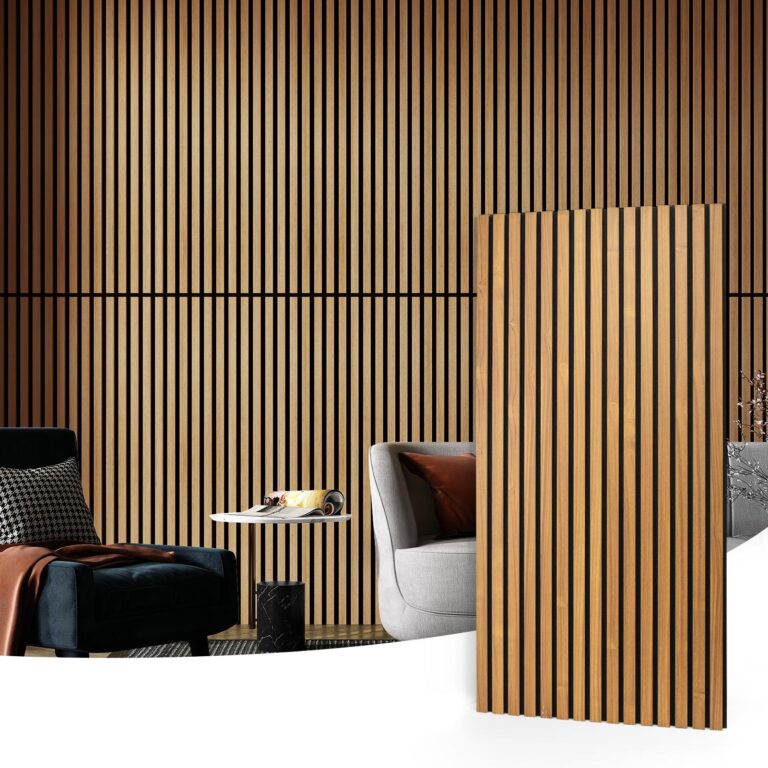
Products supplied by China WPC Wall Panel Manufacturers are commonly marketed for residential, commercial, hospitality, retail, office, and renovation projects.
Typical applications include:
- Feature walls
- Hotel interiors
- Office reception areas
- Living rooms
- Retail spaces
- Restaurants
- Apartment developments
- Commercial interiors
- Ceiling decoration
- Corridor walls
- Exterior façades
- Balcony areas
- Garden structures
- Outdoor wall cladding
Not every WPC panel is suitable for every application.
For example, an indoor decorative panel shouldn’t automatically be specified for an exterior façade. Outdoor products may need additional evaluation for weather exposure, temperature changes, moisture, UV exposure, fire requirements, fastening systems, and local building regulations.
That means your first question shouldn’t simply be, “How much is your WPC wall panel?”
Instead, explain the intended application to the manufacturer.
Why Buyers Source WPC Wall Panels From China
China has an extensive building-material manufacturing supply chain. Buyers can find factories producing everything from basic hollow profiles to decorative fluted wall panels and exterior composite cladding systems.
The main attraction is flexibility.
Depending on the factory and order volume, buyers may find options for:
- Different panel widths and thicknesses
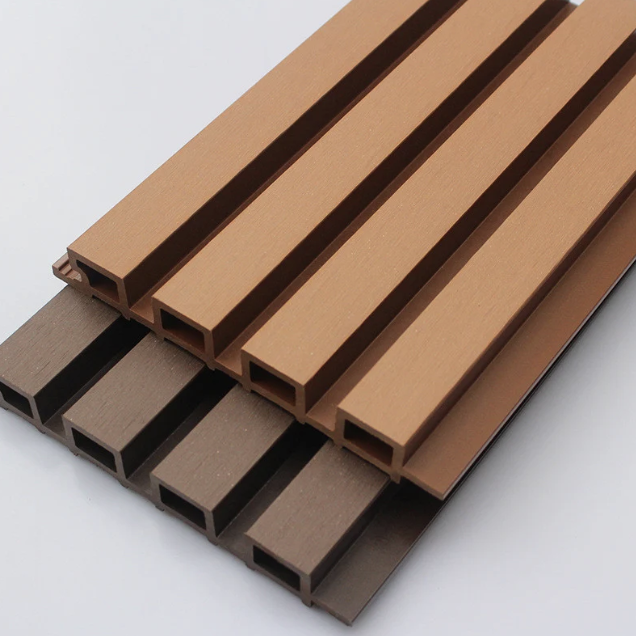
- Hollow or other profile structures
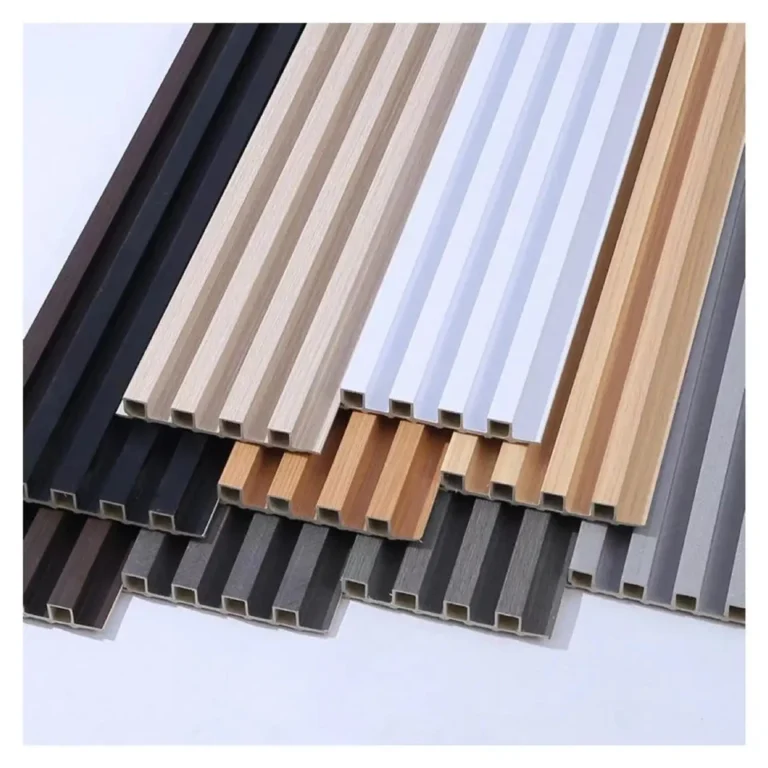
- Wood-grain surfaces
- Embossed textures
- Brushed finishes
- Solid colors
- Co-extruded surfaces
- Custom lengths
- Private labels
- OEM packaging
- Custom molds
- Matching trims and accessories
This variety can be particularly useful for distributors that want to build their own product collections.
At the same time, it creates a challenge. Two panels that look nearly identical in photographs can differ in composition, dimensions, weight, structural design, finish quality, and tested performance.
In other words, don’t judge a panel by its cover.
Manufacturing Process Matters
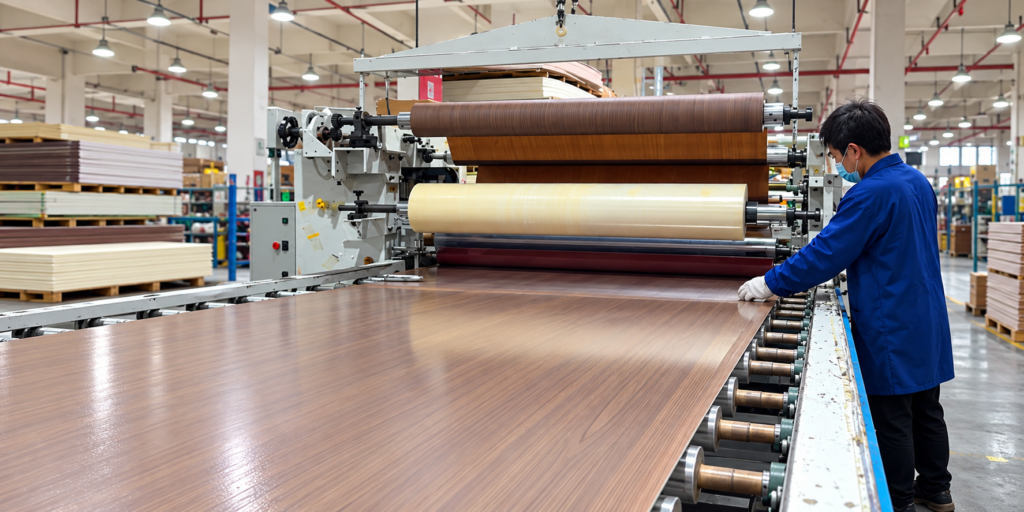
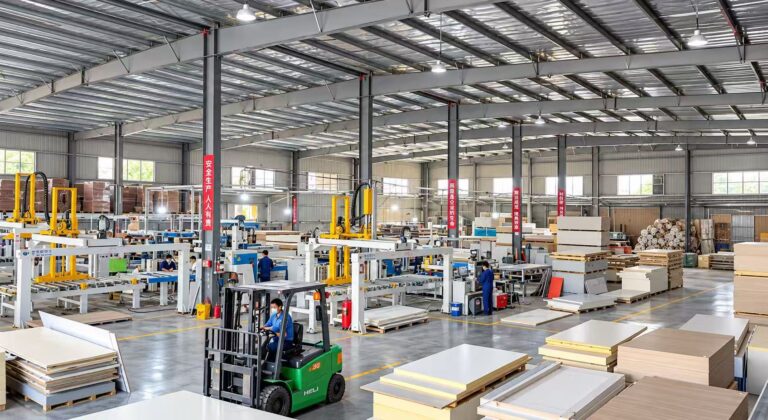
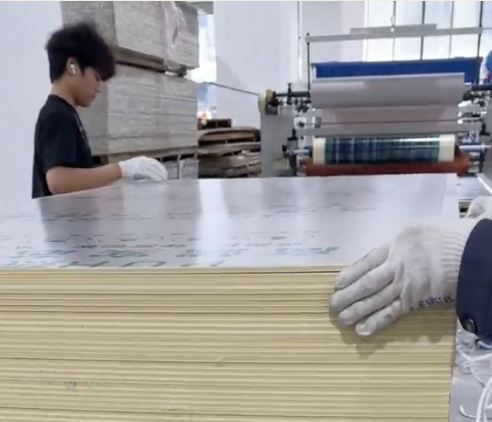
A typical WPC manufacturing process may involve material preparation, blending, extrusion, cooling, shaping, surface finishing, inspection, cutting, and packaging.
Consistency at each stage matters.
If material ratios aren’t controlled well, product performance may vary between production batches. Poor temperature or extrusion control can also affect appearance and dimensional consistency.
Surface finishing deserves attention too. Buyers often sell wall panels based heavily on appearance, so differences in color, embossing, gloss, grain, or texture can lead to customer complaints even when the panels remain usable.
That’s why experienced buyers often request an approved reference sample before mass production.
The sample becomes a physical benchmark for color, surface finish, dimensions, and general workmanship.
11 Powerful Tips for Choosing China WPC Wall Panel Manufacturers
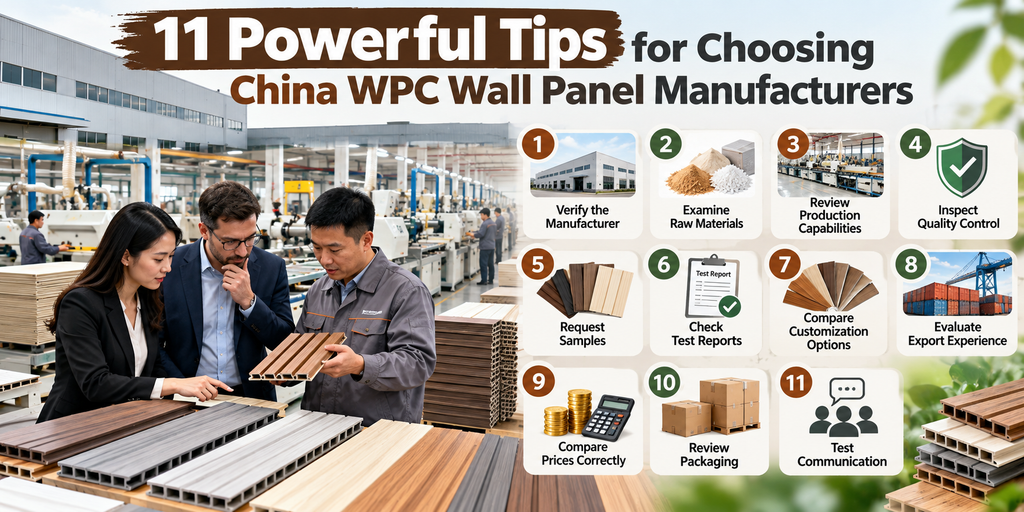
Choosing a supplier shouldn’t be based on price alone. A better approach is to evaluate the entire manufacturing and export process.
1. Verify That You’re Dealing With a Manufacturer
Start with basic supplier verification.
Ask for the company’s registered business name, factory address, business documentation, product catalog, and production information. If the order is large enough, consider an on-site factory audit or an independent third-party inspection.
A factory visit can help you examine:
- Production lines
- Raw-material storage
- Extrusion equipment
- Surface-finishing equipment
- Quality-control areas
- Finished-goods storage
- Packaging operations
- Testing equipment
There’s nothing inherently wrong with buying through a trading company. Some traders provide excellent sourcing and export services.
The key is knowing who you’re actually dealing with.
If you specifically need direct China WPC Wall Panel Manufacturers, confirm that manufacturing is genuinely performed at the stated facility.
2. Examine the Raw-Material Formulation
Don’t stop at the phrase “wood-plastic composite.”
Ask what the panel contains.
The manufacturer should be able to explain the basic material system and how it relates to the product’s intended use. You may want information about the polymer type, wood or plant-fiber component, additives, recycled content, surface layer, and any special formulation used for outdoor or fire-performance requirements.
You don’t necessarily need the factory’s confidential recipe.
You do need enough technical information to determine whether the product matches your specification.
When comparing quotations, make sure the suppliers are quoting genuinely comparable materials. Otherwise, the cheapest quote may simply represent a different product.
3. Review Production Capability
Production capacity becomes particularly important for distributors and large projects.
Ask how many extrusion lines are available for the product family you’re purchasing. Find out the normal monthly capacity, typical lead time, minimum order quantity, and ability to handle repeat orders.
Then go deeper.
Can the factory maintain the same profile and finish over multiple orders? Can it produce custom lengths? Does it have in-house tooling capabilities? How long does a custom mold take?
Reliable China WPC Wall Panel Manufacturers should be able to explain their production workflow clearly.
Be cautious when capacity claims sound impressive but can’t be supported with practical production information.
4. Inspect the Quality-Control System
Quality control should happen throughout production, not only when cartons are ready to leave the factory.
A practical QC process can include incoming-material inspection, production checks, dimensional measurements, visual inspection, batch comparison, packaging inspection, and final random checks.
Ask suppliers which characteristics they inspect.
Depending on your product, these could include:
| Inspection Item | Why It Matters |
|---|---|
| Length and width | Helps panels align during installation |
| Thickness | Supports product consistency |
| Weight | Can reveal batch or formulation variation |
| Surface finish | Important for visible decorative applications |
| Color consistency | Reduces mismatch between cartons |
| Profile geometry | Affects joints and installation |
| Packaging | Reduces shipping damage |
| Batch identification | Helps trace quality issues |
Don’t accept “100% quality guaranteed” as a substitute for an actual inspection process.
Ask how the factory measures quality.
5. Request Samples Before Ordering
Samples are one of the simplest risk-control tools available to international buyers.
Before placing a large order, request representative samples from shortlisted China WPC Wall Panel Manufacturers.
Examine the samples for surface consistency, dimensions, profile geometry, color, texture, edge quality, and general workmanship.
If panels connect through a tongue-and-groove, clip, or interlocking system, test the connection.
Put several pieces together.
A single sample can look excellent on a desk while installation problems become obvious only when multiple panels are joined.
For project-specific products, it’s also sensible to keep an approved “golden sample” or reference sample.
6. Check Test Reports and Applicable Standards
Test reports deserve careful attention.
First, identify which performance requirements apply to your market and end use. Then request reports relevant to those requirements.
ASTM International, for example, publishes standards dealing with wood-plastic composite products. ASTM D7031 provides guidance for evaluating various mechanical and physical properties of WPC products, while application-specific requirements can differ. Buyers should determine which tests are appropriate for their intended product and use.
For exterior wall coverings in relevant applications, standards and regulatory requirements may differ significantly from those for decorative interior panels.
Therefore, don’t simply ask:
“Do you have ASTM?”
Ask:
“Which standard was used, which product was tested, when was it tested, who performed the test, and does the tested construction match the product you’re quoting?”
That small change can save a lot of headaches.
7. Compare Customization and OEM Services
Customization is one reason importers work with China WPC Wall Panel Manufacturers.
Depending on quantity and factory capability, options may include custom colors, lengths, profiles, surface patterns, embossing, packaging, labels, and accessories.
For private-label buyers, ask about:
- OEM minimum order quantities
- Custom carton requirements
- Logo printing
- Barcode labels
- Installation instructions
- Color matching
- Custom molds
- Mold ownership
- Mold storage
- Exclusive profile agreements
Clarify these terms in writing before paying for tooling.
If you’ve paid for a custom mold, for example, your purchase agreement should clearly state who owns it and whether it can be used for another customer.
8. Evaluate Export Experience
A factory can produce a good panel and still be a difficult export supplier.
International orders involve commercial invoices, packing lists, shipping marks, customs documentation, container planning, and communication with freight partners.
Experienced exporters are usually more familiar with these processes.
Ask where the supplier currently exports and whether it has experience with your destination market.
However, export history shouldn’t replace compliance checks. A product previously shipped to a country isn’t automatically compliant with every building code, project specification, or regulatory requirement there.
The importer and project team still need to verify the applicable rules.
9. Compare Total Value, Not Just Unit Price
Suppose Factory A quotes $4.00 per unit while Factory B quotes $4.30.
Factory A looks cheaper.
But what happens if Factory A uses weaker packaging, has a higher minimum order quantity, charges separately for accessories, produces shorter usable lengths, or delivers less consistent finishes?
The picture changes quickly.
Compare the full landed proposition:
Total sourcing cost = product cost + packaging + tooling + inspection + inland logistics + freight + duties/taxes + expected quality-loss costs
Your exact cost model will vary by destination and Incoterm.
Also confirm whether prices are EXW, FOB, CIF, or based on another agreed trade term. Comparing an EXW quotation with an FOB quotation can produce a misleading result.
10. Review Export Packaging
Wall panels are long products, and long products can be vulnerable to shipping and handling damage.
Good export packaging should protect corners, surfaces, profiles, and decorative finishes during warehousing and transportation.
Ask the supplier for photographs of actual export packaging.
Check:
- Carton strength
- Internal protection
- Corner protection
- Pallet or bundle design
- Moisture protection where needed
- Product labels
- Batch labels
- Shipping marks
- Loading method
For large orders, requesting container-loading photographs can provide another useful record.
Packaging may seem like a small detail until an entire shipment arrives with damaged edges.
11. Test Communication Before the Big Order
Communication quality is often an early indicator of what working with a supplier will be like.
Send a detailed request for quotation to several China WPC Wall Panel Manufacturers and compare their responses.
Does the sales representative answer technical questions clearly? Are specifications confirmed in writing? Does the supplier point out missing information instead of guessing?
A professional supplier should be willing to clarify details before production.
Good communication becomes even more important when you’re ordering custom colors, special lengths, OEM packaging, or project-specific profiles.
You don’t need a supplier that says “yes” to everything.
You need one that understands what you’re asking for and can explain what it can realistically deliver.
How to Compare China WPC Wall Panel Manufacturers Before Ordering
Once you’ve shortlisted suppliers, create a standardized comparison process. This makes purchasing decisions more objective and reduces the risk of choosing a factory based only on attractive photographs or a low quotation.
Important Specifications to Put in Your RFQ
Your request for quotation should be detailed enough for every factory to quote the same product.
Include:
| Specification | Information to Provide |
|---|---|
| Application | Interior or exterior |
| Product type | WPC wall panel/cladding |
| Profile | Drawing or reference photo |
| Dimensions | Required width, thickness, and length |
| Surface | Wood grain, embossed, brushed, etc. |
| Color | Standard or custom |
| Quantity | Pieces or square meters |
| Accessories | Clips, trims, screws, profiles |
| Packaging | Standard export or private label |
| Testing | Required standards/reports |
| Destination | Country and port |
| Trade term | EXW, FOB, CIF, etc. |
| Sample | State whether approval is required |
The more precise your RFQ, the more meaningful the quotations become.
Ask the Same Questions to Every Factory
Consistency is key.
If you ask one manufacturer about material composition but don’t ask another, your comparison is incomplete.
Prepare one supplier questionnaire covering company information, product specifications, manufacturing capability, QC, testing, MOQ, customization, packaging, lead time, payment terms, and warranty policy.
Then send the same questionnaire to each shortlisted supplier.
You’ll quickly see which suppliers provide specific answers and which rely on generic sales language.
Check Whether Reports Match the Actual Product
A test certificate with an impressive logo isn’t enough.
Look at the product description on the report. Check the applicant, sample identification, testing date, standard, and result.
Then compare that information with the product being quoted.
If the report covers a different construction, profile, formulation, thickness, or product family, ask the supplier to explain the relationship.
For technical WPC evaluation, buyers can consult standards published by ASTM International. ASTM D7031, for instance, addresses test methods for evaluating a range of mechanical and physical properties of WPC products. The appropriate test program depends on the application.
Understand Interior Versus Exterior Products
This distinction deserves special attention.
Interior decorative WPC panels are often selected mainly for appearance, ease of installation, dimensional requirements, emissions requirements, and fire performance where applicable.
Exterior wall products face different conditions.
They may experience rain, humidity, direct sunlight, thermal cycling, wind, freezing conditions in some regions, and long-term outdoor exposure.
Therefore, exterior products may require evaluation of characteristics such as:
- Weathering performance
- UV resistance
- Moisture effects
- Thermal movement
- Fastener performance
- Structural behavior where applicable
- Fire performance
- Dimensional stability
- Applicable façade requirements
Requirements vary by jurisdiction and building type. Consult the relevant architect, engineer, code professional, testing body, or regulatory authority when compliance matters.
Watch for Common Supplier Red Flags
Not every warning sign proves that a supplier is unreliable, but several together should encourage deeper due diligence.
Pay attention when a supplier refuses to provide basic company information, avoids detailed specifications, repeatedly changes its quotation, provides unclear test documentation, won’t explain its QC procedure, or pressures you into a large deposit before product details are confirmed.
Another red flag is the supplier that promises every possible certification without asking about the application.
Building-product compliance is rarely that simple.
A trustworthy manufacturer should understand that requirements depend on the product, installation system, market, and end use.
Use a Supplier Evaluation Scorecard
A scorecard can make comparisons easier.
For example:
| Category | Suggested Weight |
|---|---|
| Product quality | 25% |
| Technical capability | 15% |
| Quality control | 15% |
| Testing/documentation | 10% |
| Price and commercial terms | 10% |
| Production capacity | 10% |
| Customization | 5% |
| Packaging | 5% |
| Communication | 5% |
Adjust the weighting to fit your business.
A project buyer may give testing and technical documentation more weight. A wholesaler may care more about consistent colors, packaging, repeat-order stability, and OEM support.
The important thing is to establish your criteria before comparing final quotations.
Follow a Sample-to-Order Procurement Process
For a new supplier, avoid jumping directly from a website inquiry to a full container order when practical.
A more controlled process is:
Inquiry → Specification → Supplier verification → Sample → Sample evaluation → Final quotation → Contract → Pre-production approval → Production → Inspection → Shipment
Large or technically demanding projects may require additional testing, audits, mock-ups, or pilot orders.
Before mass production begins, confirm critical details in writing.
These should include the product code, dimensions, tolerance, color, finish, quantity, packaging, labeling, accessories, testing requirements, agreed sample, lead time, inspection terms, and trade terms.
That creates a much clearer reference if a dispute occurs later.
Frequently Asked Questions About China WPC Wall Panel Manufacturers
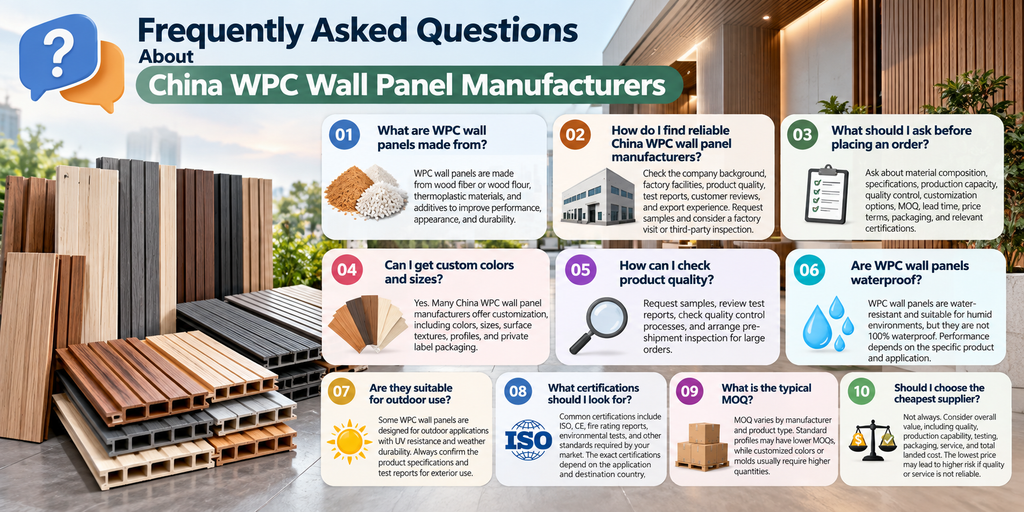
1. What are WPC wall panels made from?
WPC wall panels generally combine a thermoplastic material with wood flour, wood fiber, or another lignocellulosic component, along with additives. Exact formulations vary considerably between manufacturers and product types.
Buyers should request technical information for the specific product rather than assuming all WPC panels have the same composition.
2. How do I find reliable China WPC Wall Panel Manufacturers?
Start by identifying manufacturers that produce the specific type of panel you need. Verify company information, request product specifications and samples, examine quality-control procedures, review relevant test reports, and consider a factory audit or independent inspection for significant orders.
Don’t select a supplier based solely on the lowest quotation.
3. What should I ask a WPC wall panel manufacturer before ordering?
Ask about material composition, dimensions, tolerances, profile design, surface finish, production capacity, MOQ, customization, QC procedures, testing, packaging, lead time, payment terms, export experience, and after-sales procedures.
You should also state whether the panel is intended for interior or exterior use.
4. Can China WPC Wall Panel Manufacturers provide custom colors and sizes?
Many factories offer customization, particularly for commercial-volume orders. Options may include colors, lengths, surface textures, profiles, packaging, and private labeling.
However, customization usually depends on MOQ, production method, tooling requirements, and the manufacturer’s capabilities. Confirm all customized specifications with an approved sample before mass production.
5. How can I check WPC wall panel quality before shipment?
Use an agreed inspection specification.
Depending on the product, inspection can cover quantity, dimensions, weight, profile geometry, surface quality, color consistency, labeling, accessories, packaging, and workmanship.
For larger orders, buyers may use an independent third-party inspection company to perform pre-shipment checks.
Testing and visual inspection serve different purposes, so one shouldn’t automatically replace the other.
6. Are WPC wall panels waterproof?
It’s better not to use “waterproof” as a blanket description for every WPC product.
Composite products can offer useful resistance to moisture, but actual performance depends on formulation, profile design, surface treatment, installation, joints, substrate, and exposure conditions.
Ask the manufacturer for applicable water-absorption or moisture-related test data for the specific product.
7. Are WPC wall panels suitable for outdoor applications?
Some WPC products are specifically designed for exterior wall applications, while others are intended only for indoor decoration.
For outdoor use, verify weathering, UV, moisture, thermal, fastening, fire, and other applicable performance requirements.
Never assume an indoor WPC decorative panel can be used outside simply because the base material is described as moisture resistant.
8. What certifications should a WPC wall panel supplier have?
There’s no single certificate that proves a panel is suitable for every market.
Requirements depend on the destination country, product type, intended application, building classification, and project specification.
Buyers may need to review quality-management documentation, fire-test reports, chemical or emissions testing, mechanical or physical performance tests, CE-related documentation where applicable, or other market-specific requirements.
Verify the exact standard and product covered by each document.
9. What is the typical MOQ for Chinese WPC wall panels?
MOQ varies significantly between manufacturers.
Standard products may have lower order requirements because the factory already produces the profile and color. Customized colors, surfaces, packaging, or new molds can require larger production runs.
Instead of asking only for the MOQ, ask for the MOQ per profile and per color. That gives you a much more useful answer.
10. Should I choose the cheapest WPC wall panel factory?
Not automatically.
Price is important, especially for distributors operating in competitive markets, but it should be compared alongside specifications, quality consistency, packaging, testing, communication, production capability, and total landed cost.
A small saving at the factory can disappear quickly if panels arrive damaged or don’t match the approved specification.
A Practical Final Checklist for Importers
Before confirming an order with China WPC Wall Panel Manufacturers, make sure you can answer the following questions:
- Have you verified the supplier’s company identity?
- Do you know whether you’re buying directly from a factory or through a trading company?
- Is the product intended for interior or exterior use?
- Is the material specification clear?
- Are dimensions and tolerances written into the order?
- Have you approved a physical sample?
- Are color and surface finish clearly defined?
- Have you reviewed relevant test documentation?
- Does the documentation correspond to the actual product?
- Are packaging requirements confirmed?
- Are accessories included in the quotation?
- Have the MOQ and production lead time been confirmed?
- Is the Incoterm clearly stated?
- Is pre-shipment inspection permitted?
- Are warranty or quality-claim procedures documented?
- Are custom tooling and mold-ownership terms clear?
If several answers are “no,” there may still be work to do before sending a substantial deposit.
Conclusion
Sourcing from China WPC Wall Panel Manufacturers can give importers, contractors, wholesalers, and project developers access to a broad selection of composite wall products, customization options, and manufacturing capabilities.
But successful sourcing isn’t simply about finding the lowest price.
The stronger approach is to define the product first and evaluate suppliers against that specification.
Verify the manufacturer. Understand the materials. Request samples. Examine the production process. Review quality-control procedures. Check relevant test reports. Confirm packaging. Compare total costs. And put important requirements in writing before mass production begins.
Most importantly, match the panel to its real application.
Interior decorative panels and exterior wall cladding can have very different performance requirements. A product that looks attractive in a showroom isn’t automatically suitable for a demanding outdoor façade.
Independent standards can also provide useful technical context. For example, ASTM D7031 provides guidance on evaluating mechanical and physical properties of wood-plastic composite products, while application-specific standards and local regulations should be checked separately.
When buyers combine supplier due diligence with clear specifications and independent verification where appropriate, sourcing becomes far more predictable.
That’s the real goal when comparing China WPC Wall Panel Manufacturers: not merely finding a factory that can make a panel, but finding a manufacturing partner capable of producing the right product consistently, documenting its performance, and delivering it according to your commercial and technical requirements.